Polycystic ovary syndrome (PCOS) is not one disease. Instead, it’s “a heterogeneous disorder with different underlying biological mechanisms.” In other words, PCOS is a collection of symptoms—primarily androgen excess and anovulatory cycles—caused by different underlying mechanisms or drivers.
To effectively treat PCOS, you need to identify which mechanism (or combination of mechanisms) is driving your symptoms.
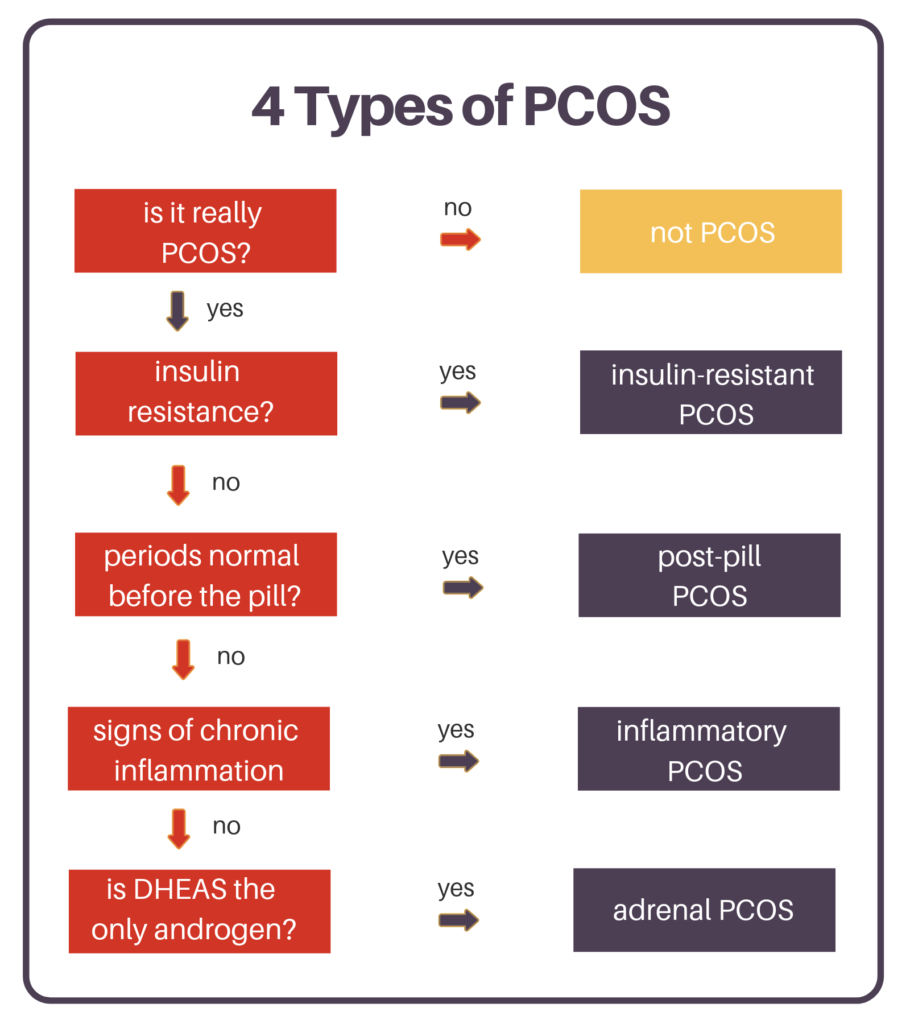
That’s why it’s helpful to identify your functional type of PCOS. These include:
- Insulin-resistant PCOS (most common)
- Post-pill PCOS (usually temporary)
- Inflammatory PCOS
- Adrenal PCOS (least common)
What is PCOS?
Polycystic ovary syndrome is best defined as androgen excess—i.e., elevated male hormones—once all other causes have been ruled out.
And despite the name, PCOS has nothing to do with ovarian cysts. The so-called “cysts” seen on ultrasound are actually just follicles, which are normal structures that contain eggs.
💡Tip: Large, abnormal ovarian cysts can cause pain and other symptoms, but they are a different issue and not part of PCOS.
In fact, as a leading expert explains:
“there is no evidence that the presence of polycystic ovaries has any implications with regard to the endocrine or metabolic features of PCOS.”
In short:
- You can have polycystic ovaries and normal hormones, or
- You can have normal-looking ovaries but still meet the criteria for PCOS due to androgen excess.

Step 1: Is it really PCOS?
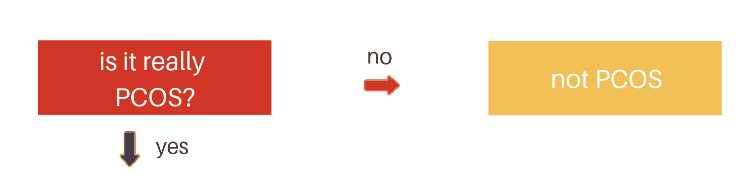
It’s PCOS if you have androgen excess, as demonstrated by 1) high androgens (male hormones) measurable on a blood test and/or 2) symptoms of androgen excess, such as facial hair or jawline acne.
Additionally, other causes of androgen excess must be ruled out, such as:
- High-androgen birth control (i.e., certain progestins)
- Congenital adrenal hyperplasia (up to 9% of androgen excess cases)
- High prolactin
If you don’t have androgen excess, then you don’t have PCOS. That’s true even if you have polycystic ovaries.
And if you’ve lost your period, consider whether your “lean PCOS” could actually be hypothalamic amenorrhea or hypothalamic suppression.
Read:
- Are you sure it’s PCOS?
- PCOS cannot be diagnosed (or ruled out) by ultrasound
- Pain is not a symptom of PCOS
If you’re certain you do have PCOS, let’s continue.
Step 2: Do you have insulin resistance?
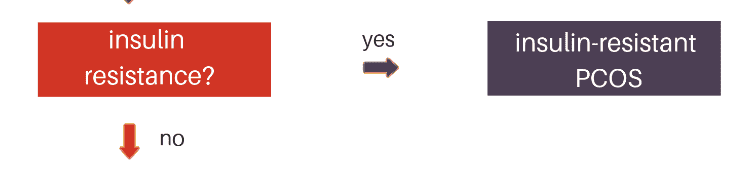
Insulin resistance means having chronically high insulin that impairs fat burning. It’s also called metabolic syndrome, and the best way to test for it is to measure triglycerides, ALT, or the hormone insulin. A normal blood glucose, HbA1C, or continuous glucose monitor cannot rule out insulin resistance.
💡Tip: For more about insulin resistance, see my book Metabolism Repair for Women.
If your insulin is high, then high insulin is driving your high androgens, and you have insulin-resistant PCOS.
The best treatment is to reverse insulin resistance with all the strategies I discuss in my new metabolism book.
💡Tip: Insulin-resistant PCOS is the most common type—affecting around 70% of those diagnosed.
If you’re certain you do not have insulin resistance, let’s continue.
Step 3: Did your symptoms start when coming off the pill?
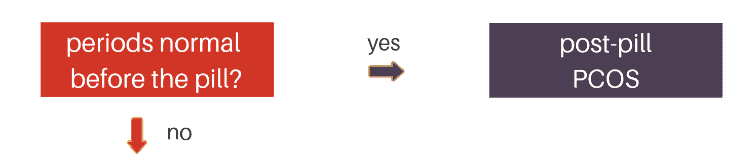
It’s common to experience a temporary surge in androgens when coming off drospirenone or cyproterone type of birth control, like Yasmin, Yaz, Diane, or Brenda. That surge in androgens is enough to qualify for the diagnosis of PCOS, even though it’s temporary.
You likely have post-pill PCOS if:
- You have androgen excess
- You do not have insulin resistance
- Your symptoms started three to six months after stopping a drospirenone or cyproterone birth control pill.
For treatment ideas, read, watch, or listen to Help for post-pill acne, hair loss, and weight gain.
If you did not just come off the pill (or spironolactone)—or if you had problems before birth control—let’s continue.
Step 4: Do you have signs of chronic inflammation?
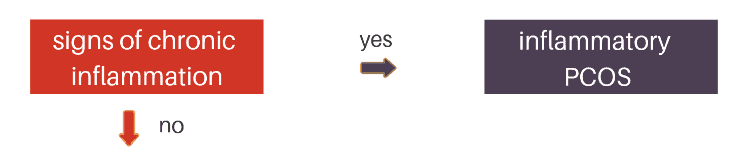
Chronic inflammation can stimulate the ovaries to make too much testosterone and is a factor in every type of PCOS. However, when chronic inflammation is the primary factor or driver, it’s inflammatory PCOS.
You have inflammatory PCOS if:
- You have androgen excess
- You do not have insulin resistance
- You’re not in a temporary post-pill phase
- You have signs and symptoms of inflammation, such as unexplained fatigue, bowel problems like IBS or SIBO, an autoimmune disease like Hashimoto’s thyroid disease, headaches, joint pain, or a chronic skin condition like psoriasis, eczema, or hives.
Treatment for inflammatory PCOS is to identify and correct the underlying source of inflammation. That could mean avoiding food sensitivities such as dairy, fixing an underlying gut problem, or addressing chronic mast cell activation or histamine intolerance. Supplements such as zinc and N-acetyl cysteine can also help.
If you do not have chronic inflammation, let’s continue.
Step 5: Do you have adrenal PCOS?

Most women with PCOS have an elevation of all androgens, including testosterone and androstenedione from the ovaries and DHEAS from the adrenal glands.
If you have only elevated DHEAS—but normal testosterone and androstenedione—you may have adrenal PCOS, which accounts for 10% of PCOS diagnoses. It’s similar to late-onset congenital adrenal hyperplasia (CAH), and menstrual cycles are often regular.
Adrenal PCOS is not driven by insulin resistance or inflammation. Instead, it’s an epigenetic upregulation of adrenal androgens. Treatments include magnesium, zinc, licorice, adaptogen herbs, and pantothenic acid (vitamin B5), which can help to regulate and normalize adrenal function.
What if you have more than one type?
The types are listed in order of priority. So, if you have insulin resistance, then you have insulin-resistant PCOS—even if you also have inflammation or are in a post-pill situation.
Anti-androgen treatment for all types
In addition to treating your underlying driver of PCOS, you may also need a natural anti-androgen supplement such as cyclic progesterone therapy. It’s suitable for all types!
Still unsure?
If you’ve been told you have PCOS but don’t meet any of these criteria, reassess the diagnosis.
Because if you do not have androgen excess, then you do not have PCOS. Consider hypothalamic amenorrhea, high prolactin, or other explanations.
For more details, see Chapter 7 of Period Repair Manual or view the full flowchart below.